Plank Road
Known as “the farmer’s railway,” plank roads were touted as a way for farmers to move their goods more easily.
In the mid-1850s, while canals, and then later railroads, provided critical and swift transport of goods over long-distances, roads were still relied upon to connect small farms to local markets. The roads were anything but ideal: depending on the weather, the roads were either muddy or dusty resulting in a slow and often damaging journey. Plank roads, known as “the farmer’s railway,” were touted as a way for farmers to move their goods more easily.
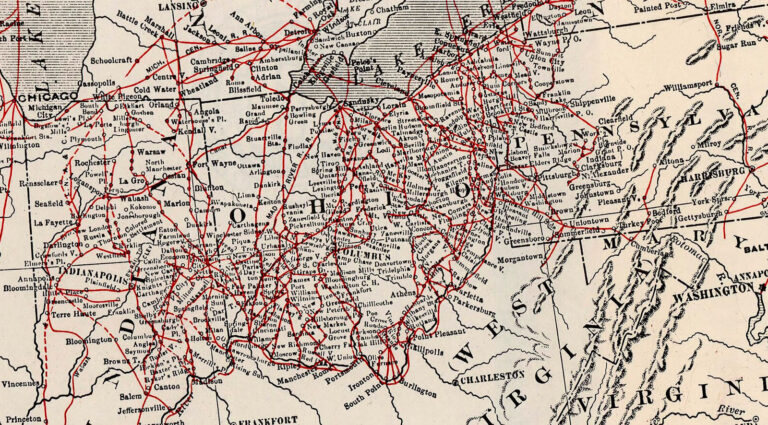
Plank roads are typically composed of two parallel lines of wood planks (4-5 feet in distance) with horizonal planks running perpendicularly. No glue or nails were required as the weight of the planks held everything in place. The first plank road opened in the U.S. in 1846, running from Syracuse to Central Square, New York. The plank road caught on quickly, and in its heyday over 1,000 plank road companies had formed laying almost 10,000 miles of road. Plank roads were especially prevalent in the Northeast and Midwest, particularly Ohio, where timber was in abundance.
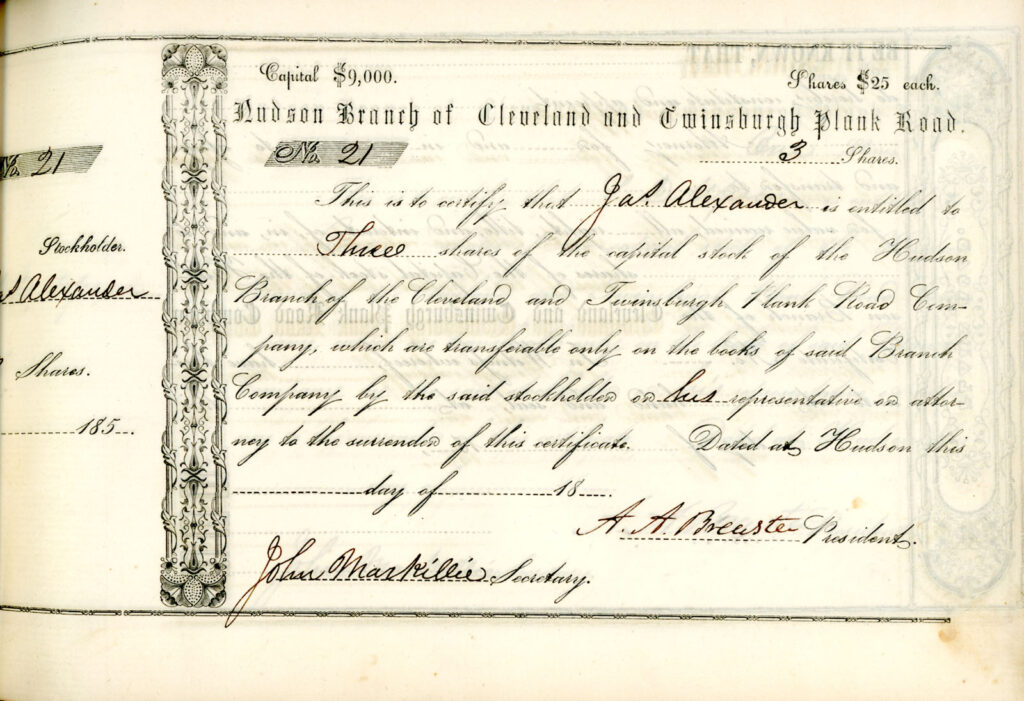
In the 1840s the citizens of Twinsburg, Ohio, and other towns along the Ohio turnpike built a plank road, first from Twinsburg to Bedford and later from the center of Hudson. Most plank roads were funded by private companies who sold shares of the investment to local citizens. Anson Alvord Brewster (1807-1864) was the president of the Hudson branch of the plank road and John Markillie (1814-1868) was secretary.
While the plank road was a significant improvement over the dirt turnpike, it was never a financial success. Many investors were sold on the fact that the roads were supposed to last for up to eight years, when most of the plank roads deteriorated after three. The cost to repair the roads was too great for investors and many companies were forced to fold. In the Hudson area, the construction of the Cleveland and Pittsburgh railway in the early 1850s changed the mail route and through-travel and much of the heavy teaming was diverted to the Macedonia road. Soon the Twinsburg plank road became only a memory of the past and remained a total loss to the stockholders.
Learn more
Archival Collections
Cleveland and Twinsburg Plank Road (Hudson branch) stock share book
A book that most likely belonged to Secretary John Markillie and was predated for 185_ (to be filled in later by the purchasing stockholder). Every single stock share page was signed by John Markillie. Those stock shares that were completed were also signed by the President A. A. Brewster. Only a handful of the pages have stockholder information present, which includes: L.C. Nelson, Sylvia Pritchard, G. D. Harris, James Alexander, L.D. Upson, Gardner Parmelee, and A. A. Brewster. Available for on-site research by appointment. View collection guide.
Other resources
Klein, Daniel B. “Turnpikes and Toll Roads in Nineteenth Century America“. Economic History Association. Archived from the original on 15 November 2016. Retrieved 7 December 2016.
Discover More Hudson History
-
Hudson Civil Defense Committee
The Hudson Civil Defense Committee was formed as part of a broader United States effort to coordinate state and federal measures for the protection of civilians in case of war or emergency
-
The Anti-Slavery Movement & the Underground Railroad in Hudson
Hudson, once called the “citadel of abolitionism,” was an active stop on the Underground Railroad and the childhood home of abolitionist John Brown
-
Hudson’s Great Fire of 1892
The April 28, 1892 fire devastated Hudson’s business district and reshaped the city’s architecture.